Vardzia
Description:
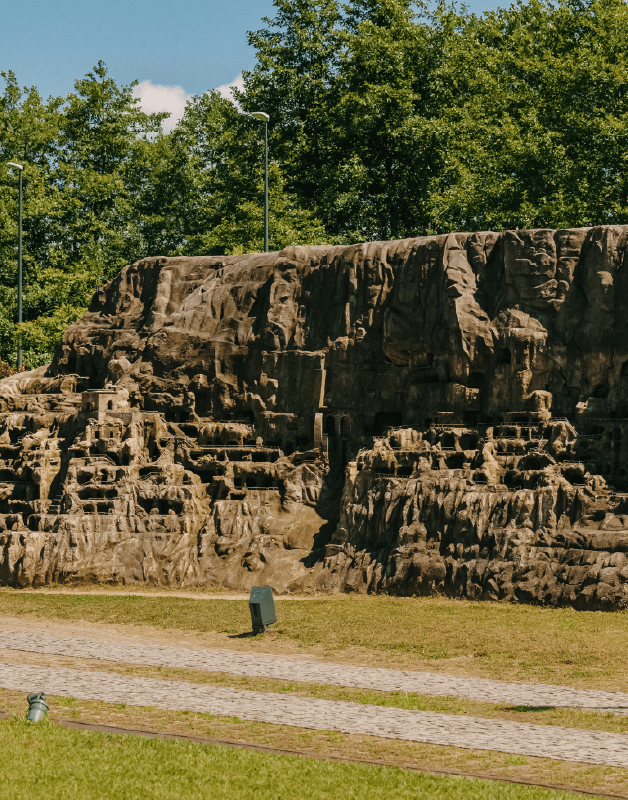
Vardzia is a rock-hewn monastic complex and one of the finest monuments of 12th-13th century Georgian artistic culture. It is located in the historic region of Javakheti, at an elevation of 1300 metres above sea level. The highest cave in the complex reaches 1,462 metres above sea level.
The fortress-city of Vardzia is arranged across multiple terraces on a cliff approximately 100 metres high. The complex consists of 13 levels and contains more than 600 chambers, including refectories, monastic cells, storage rooms, utility spaces and wine cellars.
Construction of the fortress began during the reign of King George III and was completed by his daughter, Queen Tamar, who transformed it from a military stronghold into a vast fortified monastery. The complex was mainly built between 1156 and 1203. In 1551, Vardzia was captured and devastated by Shah Tahmasp I of Iran. The Persians seized the famous icon of the Virgin Mary, the gold and steel doors, and many other treasures. In 1578, Vardzia was conquered by the Ottomans. The monastery was looted once again; some of the monks were killed, while others scattered to different regions, leaving the site abandoned. Following the establishment of Soviet rule in Georgia, a tourist centre was opened at Vardzia and in 1983, a museum was established. A few years later, religious services resumed at the monastery.
Did you know that...
1. The legend of how Vardzia got its name is probably one of the best-known stories in Georgia. According to the legend, King George III came here hunting with his nobles and brought his young daughter, Princess Tamar, with him. While everyone became absorbed in the hunt, they forgot about the child. Tamar wandered into the caves and became lost. The worried hunters searched everywhere and called out, "Where are you, Tamar?" From inside a cave, the young princess joyfully replied, "Ak var, dzia!" ("I am here, uncle!"). According to the legend, this is how the place came to be known as Vardzia.
2. Another legend tells of the construction of Vardzia. The builders initially began carving caves into a different cliff overlooking the Mtkvari River valley. However, the rock proved too fragile, making excavation extremely difficult. At the end of the day, they left their tools beside the cliff and returned home. The following morning, the tools had mysteriously disappeared. After a long search, they found them beside the cliff where Vardzia now stands. They returned the tools to the original site, but the same thing happened again the next morning. Believing this to be a sign of God's will, they decided to carve Vardzia into the new cliff instead.
3. Another legend says that, to prevent enemies from discovering Queen Tamar's whereabouts, 365 rooms were carved into Vardzia—one for each day of the year. According to the story, one room was completed every day, allowing the entire complex to be finished within a single year.
4. The Vardzia complex contains 15 churches, the most important of which is the Church of the Dormition of the Virgin. The church preserves magnificent wall paintings created by an artist named Giorgi. Among the figures depicted are King George III, Queen Tamar, and other prominent nobles. Of the four surviving portraits of Queen Tamar, the one at Vardzia is the earliest, portraying her in her youth and believed to have been painted around 1186. The church also features the Virgin Mary with the Christ Child, the Twelve Apostles, scenes from the Gospel cycle, and many other remarkable frescoes.